Solutions

Data & AI for businesses

From data strategy to AI agents. Using Microsoft technologies and industry expertise.

Data alone does not create added value. And AI is only as good as the data, processes and systems to which it has access. collana therefore links data, business intelligence and artificial intelligence along a shared value chain.

collana Glyphs
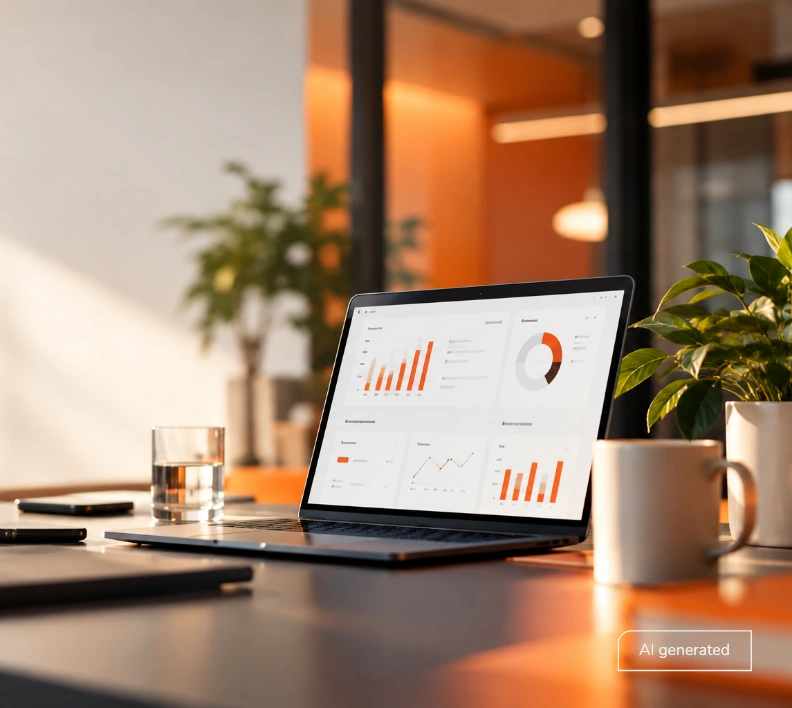
Laptop with a dashboard for data analysis in a modern office featuring collana colour accents

Data Strategy

Develop a vision and identify opportunities.

Data platform

Consolidate data from all relevant sources.

Business Intelligence

Transparent key figures for better decisions.

Artificial intelligence

Automate processes and deploy AI agents.

Safety and Operations

Data residency, network isolation and access control.

Technologies

Microsoft Fabric, Foundry, Power Bl and Azure.

Why data and AI belong together

Many AI initiatives start with the model. The crucial questions often lie one level below:

Where is the required data located? Is it accessible? Are the definitions consistent? Who is authorised to access it? And how does an AI demo become an application that works reliably with ERP, CRM or other operational systems?

The same applies to business intelligence. A dashboard can visualise data, but it cannot resolve conflicting data sources or unclear business logic.

Business process

Understanding objectives, processes and requirements

Data source

Collect and integrate relevant data

Data platform

Consolidating, modelling and providing data

Analytics & BI

Analysing data and enabling decision-making

AI & Automation

Leveraging corporate knowledge and automating processes

Not every project requires all levels. However, each level should be structured in such a way that the next one becomes possible.
Data & AI Fundamentals

Four building blocks for data and AI in business

01

Data Strategy and Governance

We provide clarity on data readiness, target architecture, governance and the key areas for action. This results in a robust roadmap for your data and AI initiatives. If the strategic direction has not yet been determined, our Data Strategy Assessment for businesses offers a structured starting point.

02

Data platform and integration

We consolidate data from ERP, CRM, e-commerce, production and other data sources to create a scalable foundation for reporting, analytics and AI. Microsoft Fabric enables data integration, data engineering and analytics to be combined on a single platform.* If the target architecture is already clear, a data sprint puts the data foundation into practice.

03

Business Intelligence and Analytics

We integrate data sources, standardise key performance indicators and develop reports, dashboards and self-service BI solutions for management and business units. We primarily use Microsoft Power BI and TARGIT, ranging from targeted reporting to an international BI platform.

04

AI, agents and intelligent automation

We develop AI solutions that harness corporate knowledge, automate processes and intelligently enhance existing business systems. Microsoft Foundry enables the development and management of AI applications and agents. For specific use cases, our AI solutions lead directly to implementation.

The right architecture for you depends on your requirements. In some cases, Microsoft Fabric – as an integrated platform – is the right choice; in others, a bespoke solution made up of individual Azure components is better. We decide this together based on your specific circumstances, not on any product preference.

AI in practice

Direct access to AI solutions

Do you already have a specific use case in mind? If so, you can dive straight into our specialist AI solutions.

Generative AI for businesses

Search through corporate knowledge, develop knowledge agents or integrate generative AI securely into existing processes.
We develop scalable solutions based on the Microsoft platform and integrate them with your data and applications.

ILAI: AI agent for service and processes

ILAI automates recurring communications and process steps via telephone, email, web chat and other channels. Through interfaces, agents can access ERP and business systems, enabling them not only to answer queries but also to carry out processes.

Offline AI and Local LLM

Not every AI application is suited to a public cloud. For particularly sensitive or isolated environments, we implement large language models locally, on-premises or within controlled private cloud architectures.

AI-powered document anonymisation

Automatically detect and anonymise personal and sensitive information in documents. The solution is particularly well-suited to organisations with high standards of data protection and traceability, and which handle large volumes of documents.
Technologies & BI platforms

Which technology handles which task?

A modern data and AI architecture does not consist of a single product. Different technologies perform different tasks.

Microsoft Fabric

Integrate, store, model and analyse data.

Microsoft Fabric brings together data engineering, data warehousing, analytics and business intelligence on a single, integrated data platform. Predictive models can be trained and run on the same platform, for example to forecast utilisation, demand and capacity.

Microsoft Power BI

Analysing data and making it understandable.
Power BI forms the reporting and analytics layer – either as an integrated workload within Microsoft Fabric, based on the same data source, or as a standalone solution with its own licensing, even without Fabric. The user interface, reports and models remain the same in both cases.

Microsoft Foundry

Develop and manage AI applications and agents.
Microsoft Foundry brings together models, agents and tools to develop, deploy and manage AI applications. Enterprise knowledge can be integrated; monitoring, security and governance support productive operations.

TARGIT

Bring reports, dashboards and analyses together in a single interface.
TARGIT is a standalone BI platform that really comes into its own when used in conjunction with Microsoft Dynamics, for example via the Business Intelligence Accelerator. As the exclusive distributor for the DACH region, we provide support throughout the selection, implementation and operation phases.

Microsoft Azure

Provide cloud infrastructure and platform services.
Microsoft Azure forms the foundation for cloud, data, integration and AI scenarios. Its cloud infrastructure and platform services enable the scalable operation of applications – from individual workloads right through to enterprise-wide platform architectures.
Enterprise-ready

Data residency, network and access

In regulated sectors, decisions are made before the first use case is implemented: where data is processed, who can access it, and whether this can be verified. We address these questions at the design stage, not after the fact.

Enterprise Security Secure data platform with a security shield, servers, global connectivity, users and cloud services.

Data residency

We determine the region in which your data is stored and processed, and document this in a transparent manner. For organisations with specific location requirements, this forms the basis for all further decisions.

Private Networking

Data and AI services do not need to be accessible via the public internet. We connect Fabric and the associated Azure services to your virtual network via private endpoints (Azure Private Link). Access to Fabric is then not via the public internet. We use managed private endpoints to enable Fabric to access your data sources.

Access and Governance

Identities and authorisations are managed via Entra ID, access is controlled on a role-based basis, and keys and secrets are stored in Key Vault. This is particularly crucial where AI accesses corporate knowledge: a knowledge agent must not combine information that a user would not be permitted to view individually.

Local operation as an option

For data classes that must not leave the corporate network, we run language models entirely on-premises. In many projects, the end result is a combination of both approaches, depending on the data classification.
A comparison of platforms

Microsoft Fabric or Microsoft Foundry – what’s the difference?

The two platforms perform different tasks and can complement one another within a shared architecture.

Microsoft Fabric

Focuses on data.

Integrate, store, transform and model data, and make it available for analytics or other applications.

Microsoft Foundry

Focuses on AI.

Develop models and agents, integrate corporate knowledge, and deploy and manage AI applications.

To put it simply:

Fabric creates the database. Foundry makes them usable for AI applications and agents.

Depending on the use case, both
Platforms should form part of the same architecture.

Where should you start?

Not every company is at the same stage.

From the first use case to a scalable landscape

From the first use case to a scalable data and AI landscape

Data and AI projects do not have to start with a transformation programme lasting several years.
A sensible starting point often involves a specific problem: a manual report, a lack of transparency across several companies, corporate knowledge that is difficult to access, or a process with significant potential for automation.

This can gradually lead to the development of a scalable architecture:

Orientation

Understanding the data landscape, objectives and use cases.

Foundation

Integrate data, ensure quality and define responsibilities.

Benefits

Implement BI, analytics or AI applications in a production environment.

Scaling

Extend architecture, governance and processes to other areas and use cases.

This ensures that, rather than isolated data or AI projects, reusable capabilities are developed within the organisation.

Success Stories

Data & AI in Practice

Our projects demonstrate the full range of our capabilities: from a central data platform, through knowledge provision and content creation, to the complete automation of service processes.

Why Data & AI with collana?

Integrating data, AI and operational systems

Data and AI projects do not end with the data platform. The real added value is created when data and AI are integrated with ERP, CRM, e-commerce, specialist applications and real-world business processes.
It is precisely these systems that teams within the collana Group implement and operate.

Microsoft Solutions Partner for Data & AI

The collana Group holds the Microsoft Solutions Partner designations for Data & AI and Business Applications. This enables us to combine Microsoft-validated expertise in data and AI with knowledge of the business applications and processes in which corporate data is generated.

From strategy to implementation

Our teams cover a range of roles: strategic consultants, data architects, data engineers, analytics engineers, AI developers, software engineers and ERP consultants. This enables us to develop a vision and then support its technical implementation.

From individual use cases to the platform

Not every business needs a central data platform straight away. We can start with a clearly defined reporting, data or AI use case and then expand the architecture in a controlled manner. In the same way, we support businesses that are already facing the challenge of standardising data and analytics across the organisation or internationally.

FAQ

Frequently Asked Questions about Data & AI

What does ‘Data & AI’ mean?

Data & AI describes the integration of data management, analytics and artificial intelligence. This includes, for example, data strategy, data integration, data platforms, business intelligence, machine learning, generative AI and AI agents. The aim is not to deploy as many technologies as possible, but to make corporate data usable in such a way that it leads to better decisions, more efficient processes and new digital applications.

Why do AI projects need a good data set?

Many AI applications require business data in order to deliver relevant and reliable results.
If data is inaccessible, inconsistent or poorly documented, even a powerful AI system is difficult to use productively.
Data quality, access rights, governance and a suitable data architecture are therefore key foundations for scalable AI.

What is the difference between business intelligence and artificial intelligence?

Business Intelligence primarily prepares company data for reporting, analysis and management.
Artificial intelligence can also generate content, recognise patterns, make predictions or automate tasks and processes.
Both areas frequently draw on the same database

Is Power BI part of Microsoft Fabric?

Power BI is the reporting and analytics layer within Microsoft Fabric, where it runs as an integrated workload on the same data foundation. At the same time, Power BI can still be licensed independently and can be used without Fabric. It was Power BI Premium per Capacity that was discontinued, not Power BI itself. Which option makes sense depends on whether, in addition to reporting, data engineering, data warehousing and machine learning are also to run on the same platform.

What is the difference between Microsoft Fabric and Microsoft Foundry?

Microsoft Fabric is a platform for data and analytics. Among other things, it supports data integration, data engineering, data warehousing and business intelligence.
Microsoft Foundry is used to develop and manage AI applications and agents.
In a modern data and AI architecture, both platforms can work together.

Where is our data processed?

We determine this together as part of the architecture. Depending on your requirements, we process data in a specified Azure region, in a private cloud environment, or entirely on-premises within your own infrastructure. For data that must not leave the corporate network, we run language models on-premises. The allocation depends on your data classification.

Can data and AI services be isolated from the public internet?

Yes. We operate the services in isolated virtual networks and connect them via Private Link, so that data traffic does not pass over the public internet. Identities and authorisations are managed via Entra ID, and access is controlled on a role-based basis.

Does a company need to set up a central data platform first before it can use AI?

No.
A clearly defined AI use case can often be launched using just a few carefully selected data sources.
However, as the number of applications, departments or data sources increases, a centralised and well-governed database becomes increasingly important for scalability, quality and operations

Does collana only work with Microsoft data sources?

No.
The Microsoft platform can integrate data from a wide range of Microsoft and non-Microsoft systems.
These include, for example, ERP and CRM systems, e-commerce platforms, databases, APIs, marketing systems, production data and bespoke business applications.

How do you get a data or AI project off the ground?

The best way to start depends on your starting point.
If there is no shared vision, a data strategy assessment may be useful. For specific data issues, a data sprint is a good option. For reporting requirements, a BI project can be launched straight away. Where the potential of AI is still unclear, relevant use cases are first evaluated and prioritised.

Do we need Microsoft Fabric for a data platform?

No. Fabric is an option worth considering if you want data engineering, data warehousing, analytics and reporting to run on a single platform. Alternatively, you can build a data platform using individual Azure components, tailored to your requirements. We’ll determine which approach is best during the architecture phase.

Best Choice for holistic consulting