

The Lindenhof Group was faced with the challenge of modernising its existing ERP system based on Microsoft Navision. The existing solution was approaching...

An IT service provider for clinics and hospitals in Switzerland must be capable of more than simply supplying software or providing technical support for individual systems. What is crucial is an understanding of how medical, administrative and business processes interact – and how technology can support these processes effectively.
This is precisely where one of the greatest challenges of the Digitalisation in the healthcare sector: IT, organisation and processes cannot be viewed in isolation from one another.
Anyone looking for an IT service provider for the healthcare sector in Switzerland today should therefore focus above all on industry expertise, integration capabilities and a holistic approach.
A suitable IT partner for a Swiss hospital or clinic should:
Technology is always only part of the solution.
There is hardly any other sector in which so many different requirements come together as in the healthcare sector.
Clinics and hospitals must ensure a high standard of care whilst operating efficiently. Medical and administrative processes are interlinked. Different systems need to exchange data. Staff require reliable applications, whilst Data protection, security and regulatory requirements must be taken into account at all times.
At the same time, new technologies, cloud platforms, automation and artificial intelligence the opportunities offered by digitalisation.
Added to this are system landscapes that have often evolved over time.
When different applications for finance, human resources, procurement, patient administration, reporting or other specialist areas operate independently of one another, data inconsistencies can quickly arise and Data silos.
The key question is therefore not:
What new software do we need?
Rather: How can we create a system and process landscape that supports our organisation in the long term?
A specialist IT service provider for hospitals in Switzerland should address precisely this issue.

Technical expertise alone is not enough in the Healthcare sector ...not.
An IT project in a hospital rarely affects only the IT department. Changes can have an impact on finance, procurement, management accounting, human resources, administration, medical processes and the day-to-day work of many staff members.
That is why a healthcare IT service provider must be able to understand the requirements of different departments and bring them together.
This includes, for example, the ability to analyse existing processes, identify interdependencies and work with the relevant departments to develop appropriate target processes.
Only then should a decision be made as to which technologies are required.
This order is important: Effective digitalisation does not start with the system, but with the process.
Many digitalisation projects begin with a specific technical challenge.
An existing application is to be replaced. An ERP system is out of date. Data is stored in different systems. Processes involve too many manual steps, or a new system is to be introduced.
However, behind these individual issues there is often a broader strategic question.
What should the IT infrastructure of the hospital or clinic look like in a few years’ time?
Which processes should be mapped centrally? Where are specialised systems required? What data is needed? What interfaces must be in place? Which processes can be automated?
A good IT service provider therefore does not merely provide support during the technical implementation.
It already helps to develop a robust solution based on the technical and organisational requirements Digital and IT Strategy to be derived.
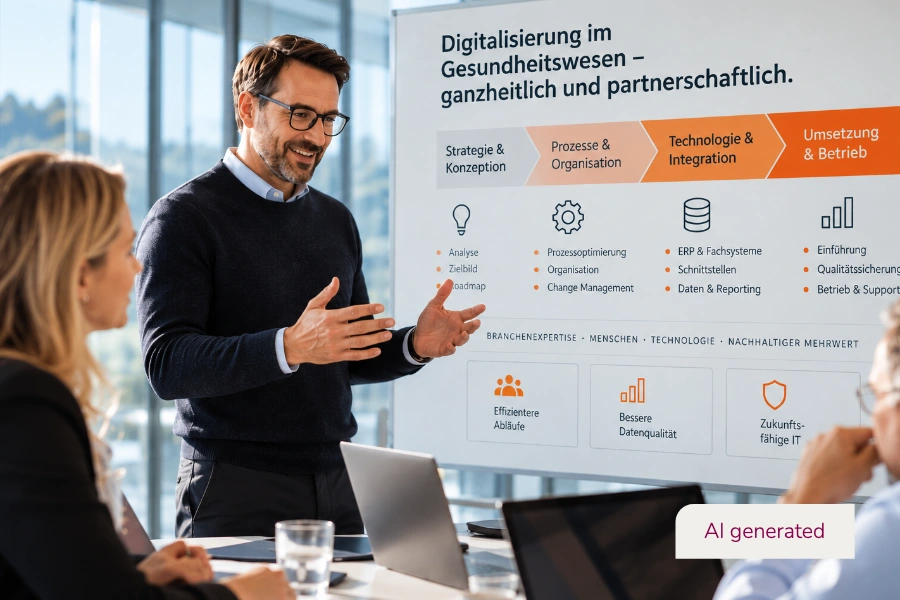
Particularly in the case of complex healthcare projects, problems often arise at the interfaces between different project phases.
Strategies are developed but not consistently implemented. Systems are introduced without processes being adequately adapted. After the go-live, there is a lack of clear lines of responsibility, or the organisation is not yet sufficiently prepared for the new way of working.
A holistic approach should therefore take the entire life cycle into account:
Which processes should be improved? Where is unnecessary effort currently being expended? Which systems are affected? What organisational changes are necessary?
These questions form the basis for a realistic target architecture.
It all starts with the organisation’s objectives.
Which processes should be improved? Where is unnecessary effort currently being expended? Which systems are affected? What organisational changes are necessary?
These questions form the basis for a realistic target architecture.
Healthcare projects often involve several specialist areas, systems and external partners at the same time.
Clear lines of responsibility, realistic planning and structured management are therefore crucial.
New systems do not have to operate in isolation, but should integrate seamlessly into the existing environment.
This involves both technical interfaces and end-to-end processes and consistent data.
Particularly in the case of business-critical systems, it is essential to ensure that processes and functions operate reliably before they are put into production.
Structured testing and clear quality assurance minimise risks at go-live.
Digitalisation does not end with implementation.
Systems, processes and requirements are constantly evolving. It is therefore important to consider, right from the start of the project, how solutions can be operated and further developed in the long term.
An important aspect of digitalisation concerns the administrative and business processes of a clinic or hospital.
Financial management, procurement, materials management, HR processes and patient administration generate large volumes of data and involve numerous interlinked processes.
If these processes are managed via separate applications, this often results in duplicate data maintenance, manual data transfers and additional interfaces.
Modern ERP systems can lay a solid foundation here.
With collana med For example, within the collana group, there is one based on Microsoft Dynamics 365 Business Central an ERP solution based on this technology, which is specifically tailored to clinics and hospitals in Switzerland.
This involves enhancing the established Microsoft platform with functions and processes required by the Swiss healthcare sector.
This allows key administrative and business processes to be more closely integrated.
Under the collana initiative, healthcare expertise is being systematically consolidated within the group
The collana health AG Based in Bern, it is the collana Group’s healthcare centre of excellence for the Swiss healthcare sector.
It supports hospitals, clinics, outpatient service providers and care homes in their digital transformation.
This support ranges from strategy and concept development, through project and quality management, to ongoing operational support.
The focus is not on any single technology.
The key lies in integrating processes, organisation and IT.
This means that collana health Different roles depending on the project – for example, as a strategic partner, project manager, sparring partner or as part of an existing project team.
This expertise is complemented by Data Dynamic AG.
The Swiss company has been developing and implementing sector-specific ERP solutions for over 50 years and combines Microsoft Dynamics 365 Business Central with its own modules and applications.
Particular emphasis is placed on clinics and hospitals, as well as care homes and social care institutions.
This combination is important: sector-specific consultancy and project management on the one hand, and ERP, process and implementation expertise on the other.
This means that digitalisation projects can be viewed not only from a conceptual perspective, but also supported right through to their operational implementation.
The importance of the interplay between different areas of expertise is demonstrated, for example, by a joint project with the The Lindenhof Group in Switzerland.
As part of the modernisation of the ERP landscape, Microsoft Dynamics 365 Business Central introduced as a central platform.
Within the collana Group, various tasks were consolidated: Data Dynamic was responsible for implementation, collana health took charge of project management and sector-specific consultancy, whilst further expertise from within the Group provided support with quality assurance.
This example illustrates an important point:
In the case of complex healthcare projects, an IT service provider does not necessarily have to carry out every task using a single team.
What is far more important is that the necessary skills work together in a coordinated manner.
The Lindenhof Group was faced with the challenge of modernising its existing ERP system based on Microsoft Navision. The existing solution was approaching...
Before entering into a partnership, it is worth asking a few key questions.
Experience in the healthcare sector from other markets can be helpful. For Swiss clinics and hospitals, however, it is also important that a provider is familiar with local structures and requirements.
References show whether theoretical expertise has already been put into practice. Projects of a similar level of complexity are particularly valuable.
Anyone who focuses solely on a specific product right from the start of a project often misses the mark. First, it is important to understand the processes, objectives and requirements.
A hospital will continue to use a variety of specialist applications in the long term. The ability to integrate systems and data is therefore a key component of modern healthcare IT.
The more systems, departments and service providers are involved, the more important it is to have clear project management. A good partner ensures not only that individual sub-projects run smoothly, but also that the overall objective remains in focus.
The introduction of a system is just one milestone.
Operation, support, optimisation and further development should therefore be taken into account right from the start.
Digitalisation works particularly well when technology solves a specific problem. For a hospital, this might mean, for example:
Which solution is appropriate depends on the specific circumstances.
That is why a good healthcare project begins with listening and understanding.
Not with a product presentation.

Anyone looking for an IT service provider for a hospital or clinic in Switzerland should not just compare technologies.
The key question is whether a partner understands the organisation as a whole.
Healthcare IT connects processes, people, data and systems. Consequently, successful digitalisation requires a range of skills: sector-specific knowledge, strategy, process consultancy, project management, technology, integration and long-term support.
This is precisely the approach taken by collana.
With collana health, Data Dynamic’s expertise in healthcare and ERP, and the additional technological expertise within the collana Group, digitalisation projects can be examined from a range of perspectives and implemented collaboratively.
The aim here is no longer IT.
The aim is to improve processes and establish a digital infrastructure that will support clinics and hospitals in the long term.
References show whether theoretical expertise has already been put into practice. Projects of a similar level of complexity are particularly valuable.
A healthcare IT service provider supports hospitals in the planning, implementation, integration and further development of digital systems and processes. This may include, amongst other things, IT strategy, process consultancy, project management, ERP systems, data integration, digitalisation and operational support. It is crucial that, in addition to the technology, the specialist workflows of a hospital are also understood.
Key requirements include experience in the Swiss healthcare sector, verifiable references, expertise in processes and technology, and the ability to manage complex projects spanning multiple specialist areas. Operations, support and long-term development should also be taken into account.
Processes in hospitals and clinics differ significantly from those in many other organisations. Healthcare provision, administration, finance, human resources and regulatory requirements are closely interlinked. Without a proper understanding of the sector, there is a risk of introducing technical solutions that do not fit in optimally with the actual workflows.
ERP systems primarily support administrative and business management processes. These include, for example, financial management, procurement, materials management, HR processes and other organisational procedures. An integrated ERP system can help to reduce data silos and manual tasks.
collana combines healthcare consultancy, project and quality management, digitalisation, and expertise in ERP and technology. With collana health, the group has a specialised healthcare centre of excellence in Switzerland. This is complemented, amongst other things, by the ERP and sector expertise of Data Dynamic AG and the collana med healthcare solution based on Microsoft Dynamics 365 Business Central.
collana combines healthcare consultancy, project and quality management, digitalisation, and expertise in ERP and technology. With collana health The group has a specialised healthcare centre of excellence in Switzerland. This is complemented, amongst other things, by the ERP and sector expertise of Data Dynamic AG and the healthcare solution collana med on the basis of Microsoft Dynamics 365 Business Central.
Are you planning a digitalisation project, looking to modernise existing systems, or searching for an IT partner for your clinic or hospital?
Home / Polish company Netwise S.A. joins the collana Group The
The collana Group has launched the video podcast *CoreShift by collana*.
The Collana Group has reached a milestone that few others have

