
The right AI strategy: buy, integrate or build it yourself?
Home / The right AI strategy: buy, integrate or build it yourself?
Many companies now realise that they need to get to grips with artificial intelligence. But as soon as it becomes concrete, a central question arises:
Should we buy in AI, integrate it into existing systems or develop it ourselves?
The answer to this depends on several factors: your own goals, the existing IT landscape, the available expertise and, of course, the budget. While some companies achieve results quickly with ready-made AI tools, others require customised solutions that are deeply integrated into their processes.
This article shows the three most important strategies for the use of AI in companies and helps you make the right decision.
Many decision-makers are looking for precisely this answer. So let's summarise it directly:
Situation | Suitable strategy |
|---|---|
Fast entry into AI | Buy AI solution |
Making existing systems smarter | Integrate AI |
Strategic or highly customised applications | Develop AI yourself |
In practice, many companies combine several of these approaches.
Artificial intelligence is rarely introduced because it is „modern“. In reality, it is almost always about very specific improvements in everyday working life.
Many processes in companies are still highly manual. Employees search for information, analyse documents, answer recurring questions or transfer data between different systems. This is precisely where AI can make a huge difference.
Typical areas of application are, for example
Automatic analysis and processing of documents
Support in customer service
Intelligent search in corporate knowledge
Automation of routine processes
Analysing large amounts of data
Especially generative AI has opened up new possibilities in recent years. Modern language models can summarise content, generate texts or serve as an intelligent assistant in everyday working life.
But the crucial point here is: Added value is only created when AI is meaningfully integrated into existing processes.
The quickest way to utilise AI is to use ready-made tools. Many providers make their solutions available as a cloud service so that companies do not have to set up their own infrastructure.
These solutions can often be introduced within a few days or weeks and are particularly suitable for getting started with AI.
Typical examples include chatbots, generative text tools and document analysis systems.
Ready-made AI solutions are therefore particularly suitable when companies want to quickly gain initial experience with AI or if there is a clearly defined use case.
Many companies are opting to integrate AI directly into their existing applications. Instead of using an additional tool, the technology is used where it is actually needed in day-to-day work.
A typical example is an ERP system that automatically analyses documents or merges information from different sources. Internal knowledge assistants or AI-based search functions are also frequently part of this approach.
The great advantage of this strategy is that AI Part of the existing processes will.
In technical terms, this integration strategy is often based on platforms such as Azure OpenAI or comparable AI services. They enable companies to specifically integrate generative AI into existing applications without having to redevelop entire systems.
On this basis, internal knowledge assistants, automated document analyses or intelligent search functions can be implemented, for example. Among other things, the collana Group develops Customised solutions based on generative AI in Azure, which can be specifically integrated into existing company systems.
In some cases, neither standard solutions nor integrations are sufficient. This is particularly true for companies where AI is to become a central component of the business model or where there are very specific requirements.
Here, own models are developed or existing systems are heavily customised.
Especially when it comes to sensitive company data or strict compliance requirements, it can make sense to operate AI entirely within your own infrastructure. In such cases, so-called Local LLMs This means large voice models that are operated locally and do not send any data to external providers.
The collana Group is also developing corresponding solutions for companies that want to operate AI entirely within their own IT infrastructure. Such Local LLM solutions make it possible to utilise AI functions while retaining full control over sensitive data.
The decision between buying, integrating or developing in-house usually depends on four key factors.
Costs
Ready-made solutions are often cheap to start with, but can become expensive if used intensively. In-house developments require a higher initial investment.
Expertise
Building your own AI systems requires data scientists, ML engineers and software developers. Without this expertise, an integration or purchasing strategy usually makes more sense.
Time-to-market
If a solution needs to be available quickly, SaaS products are often the fastest way.
Flexibility
The more individual the requirements are, the more worthwhile it is to develop your own solution or to integrate a customised solution.
Many companies do not start their AI journey directly with technology, but with a structured analysis of their processes. This involves identifying possible AI use cases, evaluating the potential benefits and checking the technical feasibility.
A structured approach helps to avoid typical bad investments and quickly identify the projects that promise the greatest added value. One example of this is the AI Discovery Workshop of the collana Group, in which companies work together with AI experts to develop specific use cases and define a realistic implementation strategy for the use of AI.
There is no one right AI strategy for all companies. Instead, there are three basic options available:
Buy AI for quick results
Integrate AI for intelligent business processes
Develop AI yourself for maximum control and individuality
Many organisations are combining these approaches and gradually developing their own AI landscape.
The decisive factor here is not the technology itself, but the question, which problems in the company really need to be solved.
AI-supported voice assistants can also significantly speed up internal processes. For example, they help employees to find information more quickly, operate systems or automate recurring tasks.
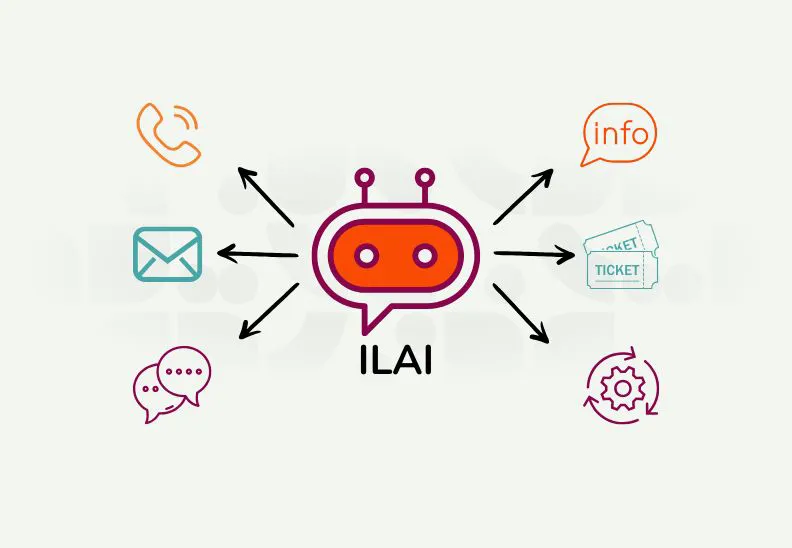
One example of this is the AI language assistant ILAI from the collana Group, which was specially developed for use in corporate environments and can support employees in their daily work.
Frequently asked questions about the AI strategy
The purchase of an AI solution is particularly worthwhile if a company wants to achieve results quickly and the use case does not require complex customisation.
If AI is to become a direct part of business processes, integration into existing software is often the most sensible solution. This allows employees to benefit directly from the new functions in their familiar working environment.
In-house development is particularly worthwhile for strategic applications, very specific requirements or strict data protection regulations.
Yes, many companies use standard solutions for general tasks, integrate AI into important processes and develop customised systems for strategic applications.
Home / The right AI strategy: buy, integrate or build it yourself?
Digitalisation is not a passing trend, but the basis for long-term success. However, many companies still work with systems that are not connected to each other.
Artificial intelligence is currently on everyone's lips. Whether in headlines, meetings or strategy papers – hardly any other topic is currently being discussed as heatedly. Many companies feel the pressure to „do something with AI“.