A data strategy sets out how a company will use its data in future, who is responsible for this, and the order in which investments will be made. It answers the questions that need to be addressed before selecting technology: where is the business-critical data located, which use cases take priority, and which architecture is compatible with the existing system landscape.
The end result is a basis for decision-making, setting out prioritised areas for action and a roadmap that your company can actually implement.
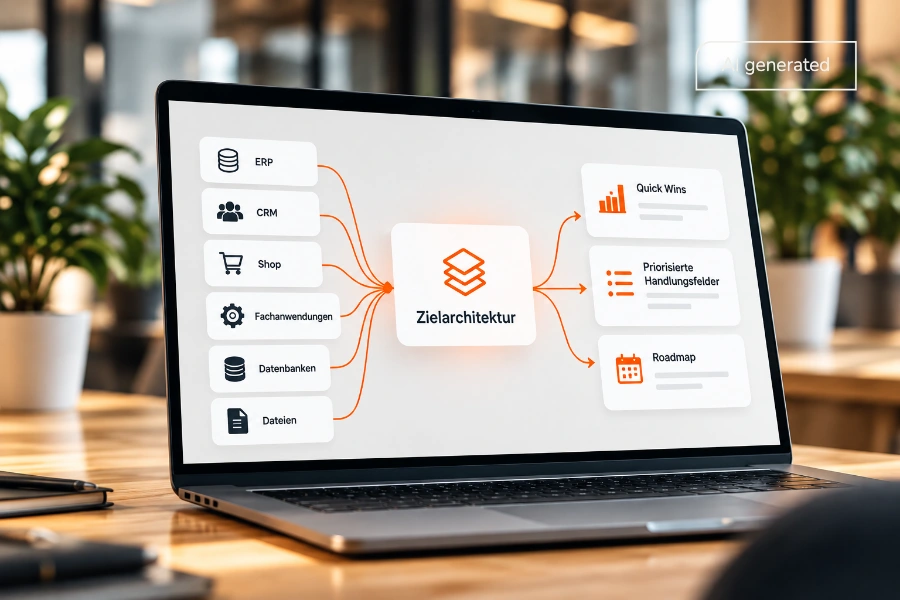
Every data strategy begins with five questions.
Which target architecture is best suited to the existing system landscape?
During the initial consultation, we will assess your current situation and determine whether an assessment is the right next step.


The results are fed into a shared loop before they are finalised.

You will receive the results to inform decisions made by senior management and the IT department.
The time required for an assessment depends on the number of source systems, the locations and the departments involved. We therefore set out the scope together during the initial meeting.
We have a team of data experts and consultants working on our side. On your side, we need senior management and IT as the commissioning parties, as well as subject matter experts from the relevant departments.
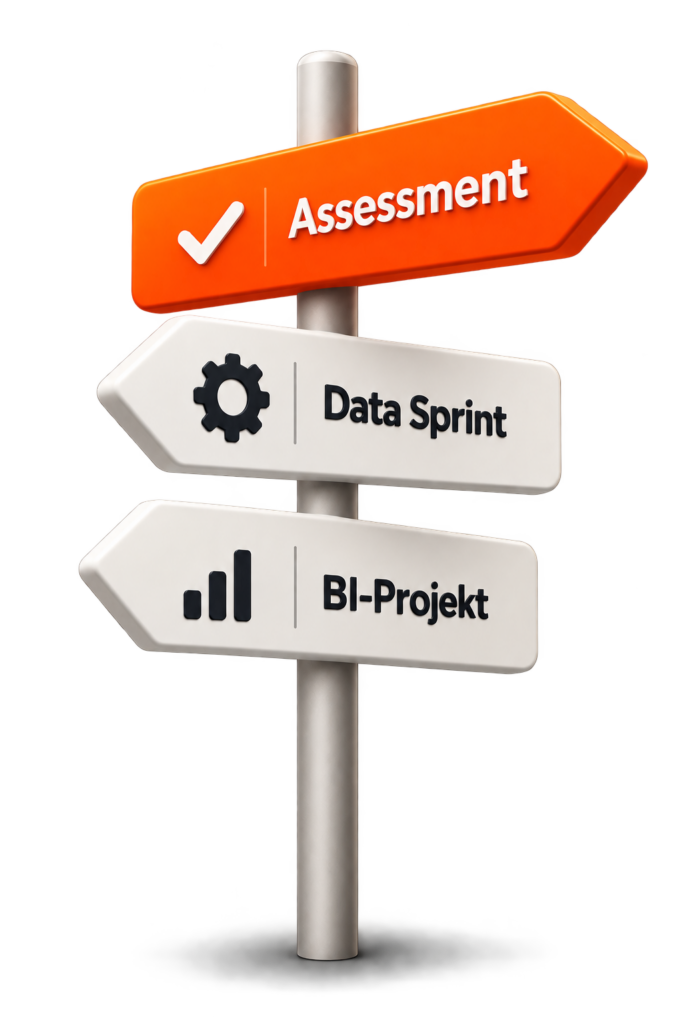
Fits, when several data projects are running in parallel without a clear end goal. Or when planned AI applications depend on the data set and nobody can say exactly why.
Doesn't fit, if the project has already been clearly defined. Anyone who knows what they want to achieve but simply does not yet have the data they need requires implementation. This is where the Data Sprint the right way.
That doesn’t fit either, when the real issue is reporting. If figures are available but are slow to come in, have to be entered manually or are inconsistent, the most direct route is via a BI project.
During the initial consultation, we will assess your current situation and determine whether an assessment is the right next step.
A data strategy sets out what data a company uses, who is responsible for it, what architecture is required, and the order in which investments are made. It aligns individual data projects with a common vision.
Not necessarily. A clearly defined AI use case can often be implemented using just a few carefully selected data sources. However, as soon as multiple departments, applications or data sources are added, it is the data infrastructure that determines whether the whole system can be operated and scaled.
There is no one-size-fits-all answer to this. It would be irresponsible to quote a figure without knowing the circumstances. The amount of work involved depends primarily on the number of source systems, the locations and the departments involved. Following an initial discussion, we can outline the scope of work for your specific case.
A data strategy sets out the direction, responsibilities and architecture. A BI project uses this as a basis to implement reporting and dashboards. Anyone who already knows which key performance indicators they need can get started with BI straight away.
Not for the assessment itself. But for the subsequent operations, yes – at least in part. Anyone wishing to use data in the long term needs people within their own organisation who are responsible for definitions and quality. Exactly what roles these are forms part of the outcome.
The focus is on the Microsoft platform, as that is where most of our customers operate. We also integrate systems from outside the Microsoft ecosystem as data sources, such as specialist applications, databases, e-commerce platforms and production data.